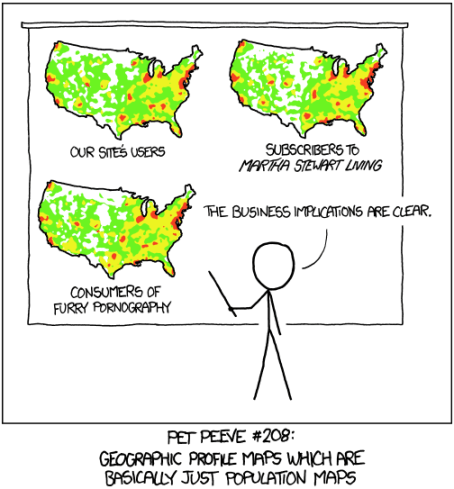
Some things don’t happen very often. Rarity makes them interesting and important, but also cryptic. Epidemiologists, insurers and bankers, the military, geographers, scholars of international relations and meteorologists all face important challenges in forecasting how likely rare events are to occur over a given period of time. Rare events matter in fundraising too; major gifts are scarce, but important. So how do we estimate the chance of big gifts occurring when only relatively few will be given across a supporter base? (Hint: it’s not via a heat map):

One popular method has been to use logistic regression, a statistical method used to illustrate how likely it is that one variable causes others to change in a given scenario. However, for various reasons, it can sharply underestimate the chance of rare events occurring, making it unreliable in forecasting. However, a new approach being pioneered by Italian academics Raffaella Calabrese and Silvia Angela Osmetti may have some answers. They propose a new statistical method to account for situations where one comparison group is very small, hopefully bypassing the underestimation issue. And another area (even more) remote from fundraising or marketing could offer some clues on gaining insight into rare events: namely, the study of civil wars. A recent paper from Rob Blair, Chris Blattman and Angela Hartman describes how the use of a set of statistical methods including neural networks, random forests and ‘LASSO’, a kind of logistic regression, can help to gain insight into the likelihood of occurrence of civil war. The paper presents three findings of interest: first, that all the methods used return results better than chance, (some are far better), and therefore have a good degree of predictive power. Second, the simplest method (LASSO) gives some of the most accurate results (hopeful for the non-statisticians among us), and, third, initial results suggest some novel causes for conflict that previous literature had not highlighted. These findings are partly based on important earlier work by Gary King and Langche Zeng, whose much-cited 2001 article is a key text in the rare event literature. This research is a step in the right direction, although obviously does not solve the thorny issue of using data and statistics to predict rare events.
For those who think this discussion should go back to the statistics chat forum it managed to escape from: think again. Developing innovative methodologies is at the heart of the challenge for fundraising in igniting sectoral growth. We all know about the 80/20 rule. But as Peter Wylie recently pointed out, for many not-for-profits, a fraction of a percent of the donor base contributes a huge majority of total giving (more like the 0.1/50 rule). This is not unique, but is acute. Wylie speculates that repeatedly asking existing donors for support is the main reason for this concentration, as is a short-term outlook in campaign planning (no doubt wealth polarisation in the wider society also plays a part). Whatever the cause, we need evidence-led philanthropy to break the 0.1/50 rule, fast. The FPS and Government austerity could between them shrink British fundraised income significantly. A tougher regulator has been appointed, big name charities are already forecasting imminent losses and data protection, if not yet nuclear, is developing not necessarily to DM’s advantage. Smart, evidence-based relationship fundraising with engaged, informed donors can help to mitigate all of these risks.
Information is the lifeblood of modern organisations, and philanthropy can suffer due to a lack of robust, granular management information on forecasted donor value. But this should not be an excuse not to try to understand the predictors of major gifts. The studies mentioned above work with far more difficult and complex environments than fundraising, and are making headway in their forecasting efforts. It is still very early days in using probabilities to gauge the effects of specific solicitation or cultivation activities on donations. While developments in arcane statistics journals will obviously not raise more money in isolation, improving our data-driven prospecting and fundraising probably will. And when major gifts are less rare, the models will predict them better, making them even less rare, meaning the models will predict them better…

 (Fund) Raising Voices